The numbers are shocking – nearly half (45%) of U.S. adults aged 18-25 know someone who has successfully used a fake ID.
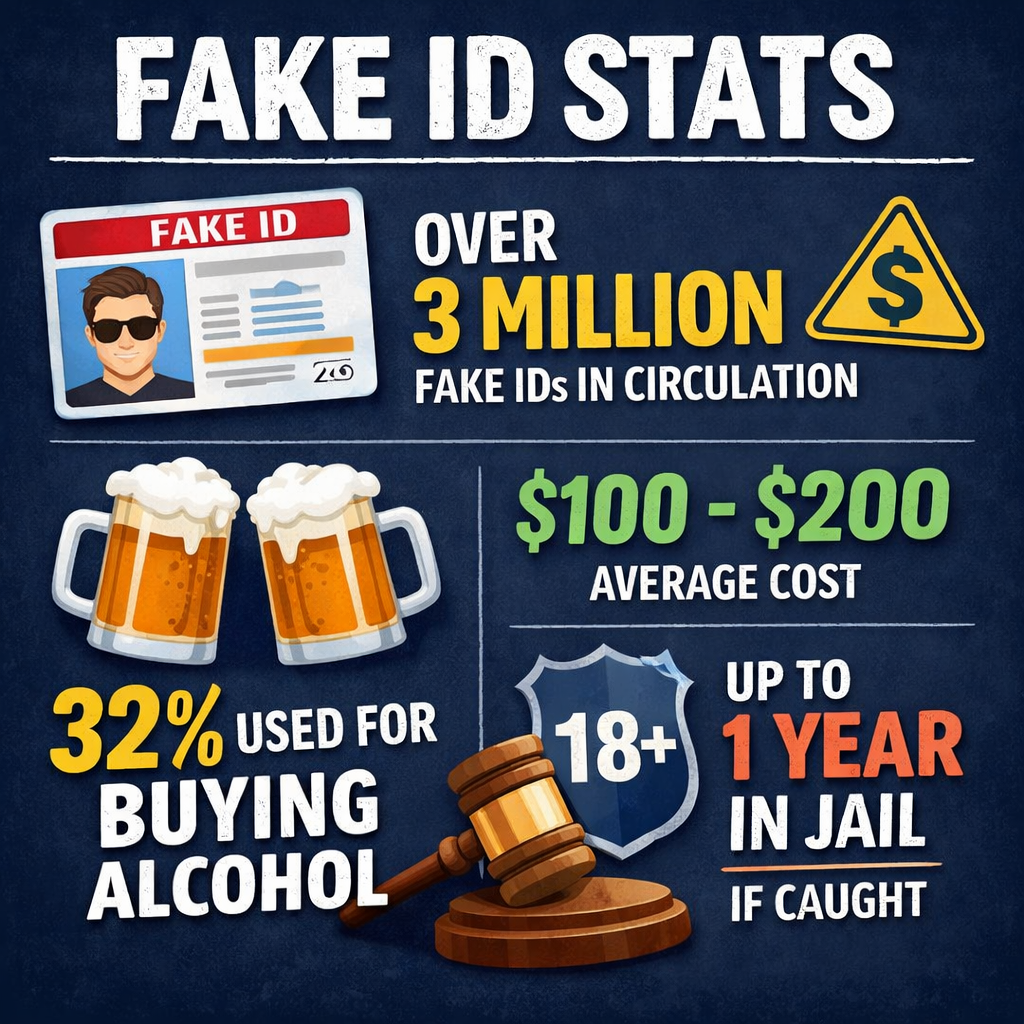
The statistics paint a concerning picture. A whopping 83.1% of college students use fake IDs just to buy alcohol. Recent data from 2024 shows that 71% of people think getting a fake ID is “somewhat easy” or “very easy.” Liquor stores bear the brunt of this problem, dealing with 56% of all fake ID attempts.
Businesses face harsh penalties when they fail to catch these fraudulent documents. The consequences can get pricey – from fines and license suspensions to criminal charges for serving minors. Negative publicity and lawsuits can destroy customer trust.
The problem goes beyond just underage drinking. Fake IDs have evolved into a complex global threat that affects financial services, government agencies, healthcare, and online platforms. The challenge keeps growing – back in 2015, about 218 million people had driver’s licenses, and that number includes both legitimate and fake IDs.
This piece will teach you how to spot a fake ID and understand the differences between fake and real IDs. You’ll learn practical techniques to protect your business. These insights will help bartenders, security professionals, and business owners stay compliant and secure.
Why Spotting Fake IDs Is Critical
The fallout from missing fake IDs goes way beyond the reach and influence of just turning away a customer. Fake ID technology keeps getting better, making it crucial for businesses and security professionals to stay alert.
Legal and financial consequences
The penalties for having fake IDs can hit harder than you’d expect. What many people think is just a harmless prank turns into a serious offense—getting caught with one can lead to misdemeanor charges with up to 12 months in jail and $1,000 in fines. But things get worse if someone uses it for work or making fakes—these become felonies that could mean 10 years behind bars.
Businesses face even bigger risks. Here are some eye-opening examples:
- A Rhode Island casino got slapped with fines of $275,000 in 2023 and $545,000 in 2024 because they let underage people onto the gaming floor
- Another casino had to pay $10,000 after they let someone from a self-exclusion list gamble
- Bar or liquor store workers might face fines up to $200,000 for each case and could spend 12 months in prison
On top of that, businesses might lose their license temporarily or forever. College students caught with fake IDs can face academic punishment like probation, suspension, or getting kicked out—this could mess up their education and future career.
Impact on business reputation
Money isn’t the only thing at stake when fake IDs slip through your checks. Research shows that about 55% of businesses got fake or changed documents in 2026. More than that, ID fraud eats up about 5% of yearly business losses, and experts say US businesses lose over $50 billion each year because of it.
Just one slip-up with ID checks can start a domino effect:
- People stop trusting you and bad press follows
- You’re on the hook if minors cause trouble in your place
- Investors get nervous when they see you as risky
- You’ll need to pay for investigations and fixes
- Regulators watch you more closely and demand more compliance
The problem works both ways—about 1 in 10 people say their real IDs got rejected as fakes, which ruins their experience and could mean lost sales.
How do people get fake IDs?
What started in college dorm rooms has turned into a high-tech underground business. These days, 71% of people say getting fake IDs is “somewhat easy” or “very easy”. The numbers tell us that about 69% of college students have owned or used a fake ID at some point.
The tech has come a long way:
- Today’s fakes come with holograms, scannable barcodes, and laser engravings
- You can buy convincing state-specific copies using cryptocurrency
- AI makes fake IDs that are getting harder to spot
- Crime rings make and sell these things in bulk
Some interesting patterns show up in who gets fake IDs—fraternity and sorority members are much more likely to get them through their Greek organizations (OR=8.02). Gender plays a role too—guys tend to buy their fakes (OR=2.74) while girls usually get them as gifts (OR=0.53).
While businesses roll out new ID checking systems, fraudsters keep finding new ways around them. This creates an endless game of cat and mouse that needs constant updates and better checking methods.
Types of Fake IDs You Might Encounter
Spotting a fake ID becomes easier when you know what to look for. Security experts have identified several distinct types of fake IDs, and each type needs specific detection methods.
Borrowed or stolen IDs
Borrowed or stolen IDs make up the most common type of ID fraud, accounting for approximately 95% of all cases. These are real government-issued documents used by someone who isn’t the rightful owner. Young people usually get these from older siblings, friends, or strangers they know.
The document itself is genuine with all security features intact. The real issue isn’t the ID card but the person using it. Watch out for:
- Facial features that don’t match the ID photo
- Differences in physical traits like height or eye color
- Nervous behavior or uncertainty when asked verification questions
- Your state’s duplicate stamp that shows the ID might be a copy
Altered government-issued IDs
Altered IDs start as real documents with changed information – they’re legitimate IDs with fake modifications. Young people usually keep all details the same except their birth date to get into age-restricted places.
You need to look closely since many security features stay intact. Look for:
- Uneven lamination over changed birth dates
- Bubbles, scratches, or odd coloring around photos
- Fonts or print quality that don’t match in edited areas
- Damaged security features from the alteration process
Forged or counterfeit IDs
Forged IDs are completely fake documents that copy real government identification. They range from simple front-only fakes to complex versions with encoded barcodes.
Front-only forgeries look real but have fake barcodes. Front-and-back forgeries (making up over 60% of cases) come with matching encoded barcodes. Counterfeiters usually can’t copy all security features found in real IDs.
Watch for these signs:
- Wrong card thickness or rough edges
- Holograms that don’t change correctly in light
- Blurry microprinting under magnification
- Square instead of rounded edges
Digital fake ID and synthetic identities
The most complex threat comes from synthetic identity fraud that creates fake credentials without linking to any real person. Unlike regular identity theft, synthetic fraud makes new identities that might not connect to anyone real.
These come in two main types:
- Manipulated synthetics: Built from real identities with small changes to SSN and other details to hide past history
- Manufactured synthetics: Completely made-up or “Frankenstein” identities created from multiple sources
These fakes are dangerous because they can last a long time. With no clear victim to report the fraud, synthetic identities can keep accounts open for months or years. They build credit and max out all accounts before vanishing. US lenders faced $3.30 billion in synthetic identity fraud losses by 2026.
Standard checks often miss these fakes since they’re designed to look real. AI-led systems offer the best protection by finding inconsistencies in digital footprints.
How to Spot a Fake ID: The FEAR Method
Security professionals use the FEAR method as an all-encompassing approach to spot fake IDs. This four-step process helps verify IDs without specialized equipment and gives you the skills needed to check identification properly.
F – Feel the ID for texture and thickness
Touch serves as your original defense. The physical characteristics of an ID tell a lot about its authenticity:
Real IDs come with specific tactile features like raised lettering, numbers, or symbols built into their security measures. To name just one example, California driver’s licenses have raised imprints of the driver’s birthdate and signature, while Texas IDs show the holder’s birthdate in raised print at the bottom of the photo.
Check for unusual thickness in the card—IDs that someone has tampered with and re-laminated feel thicker than they should. Look closely for glue lines or bumpy surfaces near the picture or birth date since these show signs of tampering.
E – Examine for visual inconsistencies
After feeling the ID, get into it under good lighting. The sort of thing I love is holding it up to spot holograms—a security feature that motor vehicle departments commonly use. Missing holograms, blurry lettering, or misspelled words raise immediate concerns.
The photo and physical description should match the person showing you the ID. This gets tricky especially when you have people changing their looks due to illness, weight changes, or other factors.
Look for poor-quality printing, mismatched fonts, or odd formatting on the ID’s back. Of course, check the edges for separation or glue buildup that might show tampering.
A – Ask questions to verify identity
While inspecting, ask the person questions about their ID details:
Can they tell you their birthdate or zip code while you hold the card? If they’re from out of state, do they know their state capital? People with fake IDs often struggle with these simple questions.
Watch their body language as you ask—avoiding eye contact, hesitating, showing nervousness, responding defensively, or looking upward shows they’re struggling to remember details.
R – Return or report based on findings
Your judgment matters in this final step. Return the ID and proceed if everything checks out. If not, stick to your establishment’s fake ID policy.
Note that you shouldn’t serve someone with a suspicious ID, but taking it away or stopping them physically isn’t recommended. Document the whole ordeal according to your organization’s rules instead.
This organized process turns ID verification from guesswork into a reliable system that streamlines your ability to catch fake identification.
Best Practices for Bartenders and Staff
A business needs more than individual expertise to verify IDs properly. The right mix of staff training and technology creates a resilient defense against fake IDs.
Regular fake ID training
Good training turns basic ID checking into skilled verification. Your staff needs hands-on practice with both real and counterfeit IDs. This builds practical skills that classroom learning alone can’t match. We focused on:
- Role-playing scenarios with ready responses to common situations
- Learning security features unique to your area
- Refresher sessions to stay watchful and current on new fake ID tricks
Local police departments are a great way to get expert training designed for businesses.
Know your state’s ID formats
Each state uses different license formats, and learning these details helps spot fakes quickly. California IDs use 1 Alpha + 7 numbers, while Florida’s have 1 Alpha + 12 numbers. Real IDs also have state-specific security marks like holograms and watermarks that forgers can’t copy perfectly.
Use ID scanners and UV lights
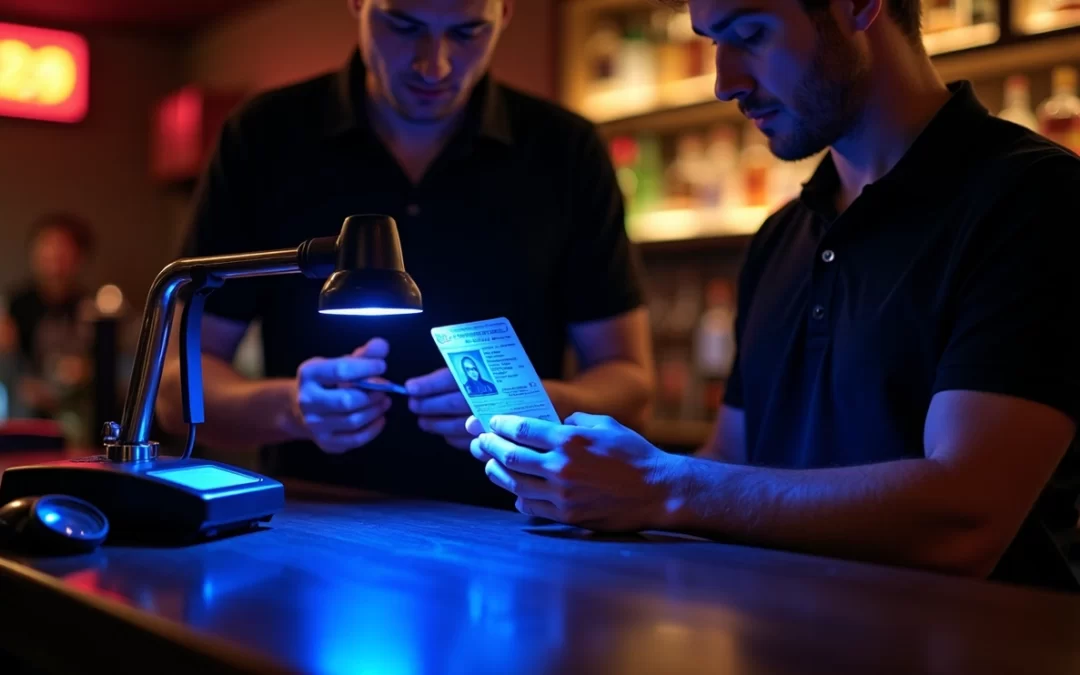
Manual checks work well, but technology adds another layer of certainty. Modern scanners check barcodes and magnetic stripes against government databases live. UV lights also show hidden security features in official IDs that counterfeiters find almost impossible to duplicate.
Document suspicious activity
Good records of fake ID incidents protect your business legally. Write down the date, time, person’s description, and what you did when you spot a suspicious ID. Many states give “good faith” protection to employees who stick to proper checking procedures.
Have a clear fake ID policy
A detailed policy helps everyone follow the same steps. ABC suggests using proven methods like the F-L-A-G system. Your policy should be clear about keeping or returning suspected fakes. If you keep the ID, give a receipt, attach a copy, keep records, and hand it to police within 24 hours as the law requires.
Common Myths and Mistakes to Avoid
Professional ID checkers often believe myths about fake IDs. These misconceptions can impact how well they verify documents.
If it scans, it’s real
The belief that scanning guarantees a genuine ID is dangerous. Studies show that fake IDs make up 10% of all scanned documents. Counterfeiters now create IDs with encoded barcodes that match the printed information and pass basic checks. Staff should combine scanning with physical inspection of the ID. Technology alone won’t catch every fake.
Only out-of-state IDs are fake
Many businesses focus too much on out-of-state IDs. The truth is that counterfeiters make fake IDs that match local state designs just as often. Staff members need to know security features from multiple states. This knowledge becomes especially important for states where most visitors come from.
Fake IDs are easy to spot
Modern fake IDs need trained eyes to detect them. Counterfeiters now copy fonts, layouts, and security features with amazing accuracy. Staff members miss subtle differences when they don’t know specific security features to look for.
Spotting fake IDs is only the bartender’s job
Many venues push all ID checking responsibilities onto bartenders. The whole organization needs to commit to proper ID verification. This means providing the right tools, training programs, and clear policies. Management should create systems where everyone shares verification duties and use technology that helps human judgment.
Conclusion
Detecting fake IDs needs alertness, knowledge, and a systematic verification process. This piece explores the complex challenge of spotting fraudulent IDs as counterfeiting technology becomes more advanced.
The numbers tell a clear story – fake ID problems are systemic and affect businesses of all types. These fraudulent documents can lead to heavy fines, license revocation, and permanent damage to your reputation.
You’ll get better at spotting fakes when you know the different types of fake IDs. Borrowed IDs make up most cases, but sophisticated counterfeits and synthetic identities need complete verification methods.
The FEAR method gives you a practical framework: Feel for texture abnormalities, Examine visual elements, Ask verification questions, and Return or report based on findings. This method turns ID checking from guesswork into a well-laid-out process.
Your business should create strong organizational protocols beyond individual efforts. The core team needs regular training, knowledge of state-specific formats, proper tech usage, and clear policies to build a strong defense against fraudulent IDs.
Common misconceptions can be just as dangerous. Many people wrongly believe that scanning guarantees authenticity or that only out-of-state IDs need careful checking.
The fight against fake IDs ended up needing both human judgment and technology. Your business faces real financial and legal risks. The knowledge and techniques in this piece will help protect your business while maintaining great customer service. Good verification procedures will pay off through compliance, reduced liability, and a solid reputation.
Key Takeaways
Master these essential fake ID detection techniques to protect your business from legal penalties, financial losses, and reputation damage while maintaining compliance with regulations.
- Use the FEAR method: Feel for texture, Examine visually, Ask verification questions, Return or report findings.
- Don’t rely solely on scanners—10% of scanned IDs are fake; combine technology with manual inspection.
- Borrowed/stolen real IDs account for 95% of cases; focus on person-to-ID mismatches, not just document quality.
- Train all staff regularly on state-specific security features and establish clear organizational policies.
- Document suspicious incidents thoroughly to protect your business legally and maintain compliance records.
The consequences of missing fake IDs are severe—businesses face fines up to $200,000 per incident, license suspension, and potential criminal charges. With 83% of college students using fake IDs and modern counterfeits becoming increasingly sophisticated, systematic verification isn’t optional—it’s essential for business survival.
FAQs
Q1. What are some key signs of a fake ID? Look for mismatched photos or personal data, suspicious barcode information, uneven surfaces, and poor quality holograms. Also check the card’s thickness and edges for signs of tampering.
Q2. How can I verify an ID’s authenticity? Examine the ID’s security features like holograms, embossing, and UV marks. Use direct light to check for precise perforations. Compare the ID to known state standards and feel for any irregularities in texture or thickness.
Q3. Is scanning an ID enough to determine if it’s real? No, scanning alone is not sufficient. About 10% of scanned IDs are fake, so combine electronic verification with visual and tactile inspection for best results.
Q4. Should I only be suspicious of out-of-state IDs? No, focus on all IDs equally. Counterfeiters often create fake IDs matching local state designs. Familiarize yourself with security features from multiple states, especially neighboring ones.
Q5. What should businesses do to improve fake ID detection? Implement regular staff training on ID verification, use ID checking guidebooks, employ UV lights and ID scanners, establish clear organizational policies, and thoroughly document any suspicious incidents.